
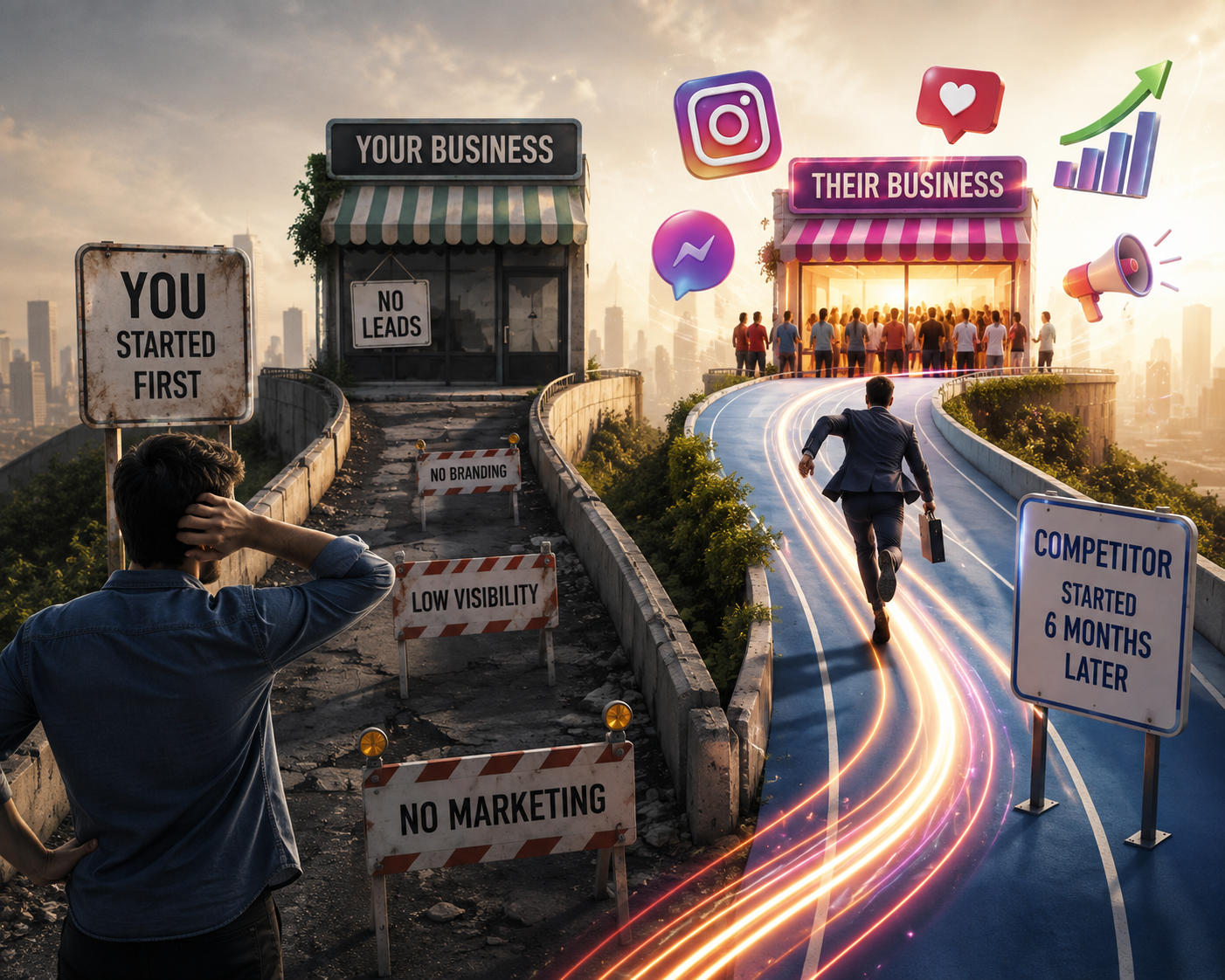
You started your business first.
You opened your shop, launched your service, created your social media pages and started waiting for customers.
Six months later, another business entered your market.
They had less experience.
They were newer.
They may even be selling almost the same product or service.
Yet somehow, they are getting more enquiries.
So what went wrong?
The uncomfortable answer is that being in business longer does not automatically make you more visible online.
In today's India, especially in Tier 2 and Tier 3 cities, your competitor does not necessarily need to be better than you.
They may simply be easier to find, easier to trust and easier to contact online.
That difference can have a massive impact on lead generation.
Recent market data shows how quickly India's smaller cities are becoming important digital markets. Tier 2 and Tier 3 cities are expected to contribute nearly 66% of new D2C orders in FY26, while Google research has highlighted the growing role of online Search, video and digital touchpoints in purchase journeys beyond India's major metros.
So if your business is based in a city such as Indore, Jaipur, Lucknow, Patna, Ranchi, Guwahati, Bhubaneswar, Nagpur, Dehradun, Raipur, Jodhpur, Surat, Coimbatore, Mysuru or another growing Indian city, this matters to you.
Your competitor may not have started earlier.
They may simply have started marketing better.
The Real Reason Your Newer Competitor May Be Getting More Leads
There is a common misconception among small business owners:
Unfortunately, customers do not always reward businesses based on age.
They reward businesses they can discover and trust.
Imagine someone in your city needs a service.
At every step, your competitor has an opportunity to appear.
If your business isn't visible at those moments, your years of experience may never enter the customer's decision.
This is why digital marketing for small businesses in India has become increasingly important.
Your Competitor Is Easier to Find on Google
Let's say you own a:
A potential customer searches:
If your competitor appears before you, they have already won the first battle.
The customer may never know that your business has been operating for six months, two years or ten years longer.
This is where local SEO becomes critical.
Your Google Visibility Matters
Your Google Business Profile, website, reviews, location information, photos, services and overall online presence can influence whether potential customers discover your business.
And for businesses in Tier 2 and Tier 3 cities, local search can be particularly important because many purchase decisions still have a strong geographical element.
Google has previously reported that online research plays a significant role even when purchases happen offline, including among consumers in India's rural heartland.
Your customer may discover you online and walk into your physical store later.
Digital visibility can create offline business.
Your Competitor May Have a Better Google Business Profile
This is one of the most overlooked areas of local lead generation.
Your competitor may have:
Meanwhile, your Google Business Profile may have been created two years ago and forgotten.
If so, you have a visibility problem.
And it isn't necessarily because your business is worse. Your digital storefront simply isn't being maintained.
Think of Google Business Profile as the front door of your business on Google.
Would you leave your physical shop dirty, dark and outdated?
Probably not.
So why would you leave your digital storefront that way?
Your Competitor Is Probably More Active on Social Media
You might have 2,000 followers.
Your competitor might have 700.
Yet they are getting more enquiries.
Why?
Because followers are not the same as leads.
A business can have a small audience and still generate customers if its content is designed around the right audience and the right action.
Your competitor may be posting:
Meanwhile, you may be posting:
The problem isn't that these posts are bad.
The problem is that they may not give the customer a reason to act.
A stronger social media marketing strategy connects content with the actual customer journey.
They Are Creating Content for Their City — Not for Everyone
This is especially important for businesses in India's Tier 2 and Tier 3 cities.
A local business does not necessarily need millions of views.
It needs the right 500 people in the right city to see its content.
Imagine a restaurant in Guwahati.
Getting 100,000 views from people in Delhi may look impressive.
But getting 5,000 views from people around Guwahati who are actually interested in dining could be far more valuable.
This is why hyperlocal digital marketing matters.
Your content can include:
The goal is not:
“Get more views.”
The goal is:
“Get discovered by more potential customers in our market.”
Your Competitor May Understand WhatsApp Marketing Better
For many Indian businesses, especially local businesses, the customer journey does not end on a website.
It moves to WhatsApp.
A customer sees an Instagram Reel.
They click the WhatsApp button.
They ask:
“Price?”
“Do you deliver?”
“Can I book tomorrow?”
That is a lead.
Your competitor may have made this process extremely easy.
You may still be asking customers to:
The easier you make communication, the less friction there is between interest and enquiry.
Your Competitor Has Better Reviews
Trust is one of the biggest reasons a customer chooses one business over another.
Consider two businesses.
Business A
★★★★☆
37 reviews
Last review: 8 months ago
Few photographs
No recent updates
Business B
★★★★★
312 reviews
Recent customer photographs
Regular updates
Detailed responses
Testimonials
Which one feels safer?
Even if Business A has been operating for five years longer, Business B may appear more active and trustworthy.
This is why online reputation management matters.
Reviews aren't just numbers.
They are digital proof.
And for businesses trying to grow in competitive local markets, proof can be the difference between:
Your Website May Be Losing Customers
You may be thinking:
That's good.
But having a website and having a lead-generating website are two different things.
Your competitor's website may answer the customer's questions faster.
If your website makes the customer search for these answers, they may leave.
A good business website should not simply say:
“Welcome to our website.”
It should move the customer toward an action.
If your business needs a stronger digital storefront, website development can help turn your website into a more effective customer acquisition tool.
Your Competitor May Be Using Paid Ads More Strategically
You may have tried Facebook or Instagram advertising before.
Maybe you spent ₹5,000.
Nothing happened.
But that's not necessarily true.
The problem may have been the strategy.
A successful local advertising campaign requires more than pressing the “Boost Post” button.
Your competitor may be targeting:
They may also be testing different:
Paid advertising works best when it is treated as a system rather than a one-time experiment. That includes both Google Ads and Meta Ads.
They May Be Speaking the Language of Their Customers
This is one of the biggest opportunities in India's smaller cities.
India's digital audience is not one uniform audience.
A customer in Bengaluru may behave differently from a customer in Bhubaneswar.
A customer in Jaipur may respond differently from someone in Guwahati.
A customer in Patna may prefer different communication styles from someone in Pune.
That doesn't mean every campaign needs to be completely translated into a regional language.
But it does mean businesses should understand:
How does my customer actually speak?
Sometimes the difference is simply using a familiar phrase.
Sometimes it is using Hindi, Bengali, Assamese, Marathi, Tamil, Telugu, Odia or another regional language.
Sometimes it is using local cultural references.
The objective is simple:
Make the customer feel that the business understands them.
Your Competitor Is Building a Brand — While You Are Selling a Product
This is a major difference.
“We sell premium furniture.”
“We help Indian families create beautiful homes without overspending.”
The second statement is more emotional.
It gives the customer a reason to connect.
This is the difference between selling and branding.
A strong brand creates familiarity before the customer is ready to buy.
When the customer finally needs the product or service, your business is already in their mind.
If your business needs to build stronger brand recognition, explore our branding services.
They Started Digital Marketing Earlier — Even Though They Started the Business Later
This is perhaps the biggest reason of all.
Your competitor may have opened six months after you.
But they may have started:
So while you were building your business offline, they were simultaneously building their digital presence.
Six months later, they have accumulated:
Digital growth compounds.
The earlier you build the foundation, the more data and authority you can accumulate over time.
The Real Difference Is Not Age. It's Visibility.
This is the part every business owner should remember.
Your competitor being newer does not mean they are better.
They may simply be:
That is why the question should not be:
Instead ask:
“Where are they being discovered that we aren't?”
That question can completely change your marketing strategy.
A Simple Digital Marketing Audit for Your Business
If your competitor is generating more leads, review these ten areas.
Website
Need a stronger website? Explore BIGBEANS DIGITAL website development.
Social Media
Advertising
For targeted paid campaigns, explore Google Ads and Meta Ads.
Reputation
If you find weaknesses in several of these areas, your problem probably isn't your business.
It's your digital marketing system.
Why Tier 2 and Tier 3 Indian Cities Are a Huge Opportunity
For years, digital marketing conversations in India focused heavily on Mumbai, Delhi, Bengaluru, Hyderabad, Chennai and other major metros.
That is changing.
India's smaller cities are becoming increasingly important markets for digital businesses and consumer brands.
Recent reporting indicates that Tier 2 and Tier 3 cities are expected to account for a significant share of new D2C orders in FY26.
Google has also highlighted the growing influence of non-metro consumers and the importance of hyperlocal marketing. In one recent example, Zomato's localized campaign targeting Tier 2 and Tier 3 cities reportedly tripled new users in those markets.
This creates an enormous opportunity for local businesses.
You don't have to compete with every business in India.
You need to dominate your market.
Imagine becoming the business people in your city see repeatedly when they:
That is what strong local digital marketing should accomplish.
What Should You Do If Your Competitor Is Already Ahead?
Don't panic.
And don't immediately copy them.
Start with an audit.
Step 1: Find Where They Are Winning
Search your most important keywords on Google. Check Google Maps. Search your city + your service. Look at Instagram. Look at their website. Read their reviews. Study their advertisements.
Step 2: Identify Your Biggest Gap
You may discover that your biggest problem is:
Don't try to fix everything at once. Fix the biggest bottleneck first.
Step 3: Build a Local Content Strategy
Create content specifically for your market.
A consistent social media marketing strategy can help distribute this local content to the right audience.
Step 4: Make It Easy to Enquire
Your customer should never have to hunt for your contact details.
Every additional step can create friction.
The BIGBEANS DIGITAL Take
At BIGBEANS DIGITAL, we believe one of the biggest misconceptions among Indian small businesses is that marketing is simply about posting on social media.
It isn't.
Effective digital marketing is about creating a system where the right customer can:
Discover you → Understand you → Trust you → Contact you → Become your customer.
And this is particularly important in India's Tier 2 and Tier 3 cities.
The next big customer may not come from a billboard.
Your job is to make sure your business is ready when that moment happens.
Because your competitor doesn't need to have a better business than yours.
They just need to be better at being found.
Your Competitor Opened Later. So Why Are They Getting More Leads?
Your competitor opened six months after you.
So why are they getting more leads?
Maybe they have a better product.
Maybe they have better pricing.
But very often, the answer is much simpler.
They have built a better digital presence.
The good news?
You can still catch up.
You don't need to become the biggest business in your city overnight.
You need to become easier to find, easier to trust and easier to contact.
Because in today's India, especially in growing Tier 2 and Tier 3 cities:
The business that gets noticed first often gets the enquiry first.
And the enquiry that gets handled best can become the customer.
Frequently Asked Questions
Why is my competitor getting more leads than my business?
Your competitor may have better online visibility, local SEO, Google Business Profile optimisation, social media content, online reviews, paid advertising or a more effective website. Business age alone does not determine lead generation.
How can a small business get more leads in a Tier 2 or Tier 3 city?
Focus on local SEO, Google Business Profile optimisation, social media marketing, local content, customer reviews, WhatsApp lead generation and targeted advertising. The goal is to become highly visible within your specific market rather than trying to reach everyone.
Is social media enough to generate leads?
Not always. Social media can generate awareness and enquiries, but businesses often need a combination of social media, SEO, Google Business Profile, website optimisation, paid advertising and reputation management.
Should local businesses invest in Google Ads?
Google Ads can be effective when targeting high-intent local searches and when the landing page and lead-follow-up process are strong. Advertising should be measured based on qualified leads and conversions rather than clicks alone.
How important is Google Business Profile for local businesses?
It can be extremely valuable for businesses that depend on local customers because it helps people discover information about the business when searching on Google and Maps. Keeping the profile accurate, active and supported by genuine customer reviews is an important part of local digital marketing.
Should businesses in Tier 2 and Tier 3 cities use regional languages?
Regional-language or bilingual content can be valuable when it reflects how the target audience actually communicates. The right approach depends on the city, audience, category and buying journey.
Can a newer business outrank an older business on Google?
Yes. Business age alone does not guarantee higher search visibility. Search visibility depends on many factors, including relevance, content, website quality, local signals, authority, user experience and competition.
How long does it take to improve local SEO?
There is no universal timeline. Results depend on the market, competition, website, existing authority, content, Google Business Profile, reviews and the quality of the SEO work. Businesses should think in terms of consistent improvement rather than instant rankings.
Ready to Find Out Why Your Competitor Is Getting More Leads?
Your business may not need another random social media post. It may need a proper digital marketing strategy.
BIGBEANS DIGITAL helps businesses build stronger online visibility through social media marketing, branding, creative content, SEO, paid advertising and digital growth strategies.